How to Prove You Didn't Use AI: Building an Evidence Ladder Before and After a Flag
A detector flag arrives as a percentage on a screen, usually with no explanation attached, and the student is expected to answer it. Knowing how to prove you didn't use AI comes down to one principle: the finished essay is the last thing you produced, and everything before it is evidence. Dated drafts, an outline, reading notes, the document's version history, the sources you opened, and your ability to talk through your own argument all show a process that a generated text never had. This guide lays that evidence out in order of strength, and it is honest about what persuades nobody.
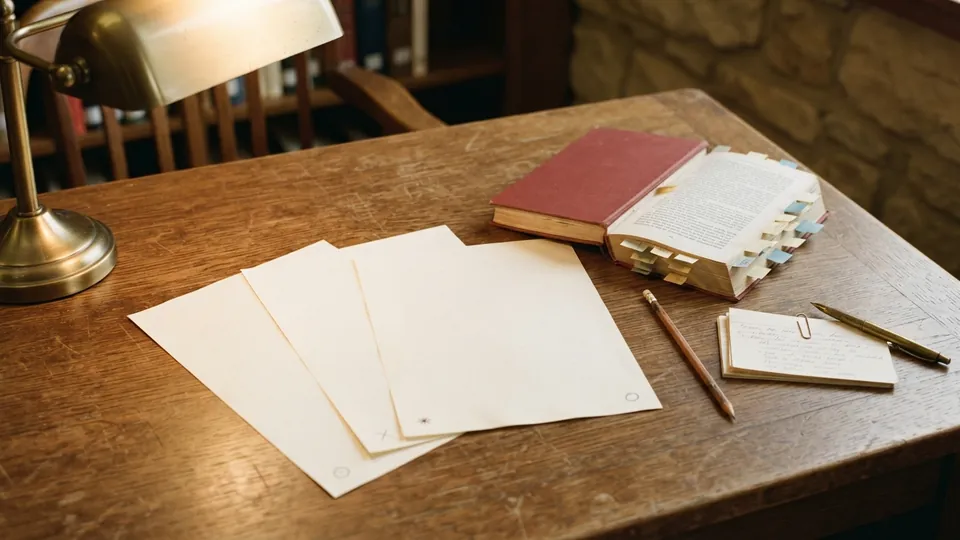
In short: You prove you didn't use AI by showing the process that produced the essay: dated drafts and named versions, an outline and reading notes, the document's edit history, the sources you consulted, and a short spoken walkthrough of your argument. A screenshot of a detector saying "human" proves nothing. A paper trail does.
Why a flag opens a conversation instead of ending one
Start with what the accusation rests on. AI detectors measure statistical regularities in text, and they misfire on real student writing often enough that serious institutions have stopped trusting them. In August 2023 Vanderbilt University disabled Turnitin's AI detection feature, noting that Turnitin had claimed a 1 percent false positive rate at launch; against the 75,000 papers Vanderbilt submitted in 2022, that rate would have mislabeled around 750 student papers. Turnitin, the university added, gave no detailed account of how the tool reached its verdicts.
The bias is uneven, too. A 2023 study by Weixin Liang and colleagues at Stanford tested widely used GPT detectors on essays by native and non-native English writers and found that the detectors consistently misclassified the non-native samples as AI-generated while identifying the native samples correctly. Plain, careful, conventional prose is what a detector reads as machine output, and it is also what schools teach.
So a flag is a claim that needs support from somewhere other than the detector. Our guides on authorship and integrity cover the mechanics; the piece on why detectors produce false positives explains the statistics. This article is about what you bring to the table.
How to prove you didn't use AI: the evidence ladder
Think of authorship evidence as a ladder. Each rung is something a real writing process leaves behind and a generated text does not. The lower rungs are easy to produce and easy to dismiss; the upper rungs are harder to fake and harder to argue with. Show as many as you honestly can, and make sure they agree with each other.
| Rung | What it is | What it shows an instructor | Strength |
|---|---|---|---|
| Your prior work | Earlier graded essays, in-class writing | The flagged essay sounds like you, habits and weaknesses included | Moderate |
| Outline and notes | A dated outline, a list of passages, a question to answer | The argument existed before the prose did | Moderate |
| Reading annotations | Underlining, marginal notes, sticky tabs | You met the text and reacted in specific places | Moderate to strong |
| Dated drafts | Saved versions that differ in thesis, evidence or structure | The essay changed over time the way a writer changes it | Strong |
| Version history | The automatic edit log of a cloud document | Hours of typing and rearranging, timestamped by the software | Strong |
| Sources consulted | Library checkouts, annotated PDFs, a bibliography that matches the essay | The research happened and the citations are real | Strong |
| Oral walkthrough | Five minutes explaining thesis, evidence and one choice | The argument lives in your head as well as on the page | Strongest |
Two rungs deserve a closer look because students underrate them. The first is version history, which cloud word processors keep without being asked. Google Docs records every editing session and lets the owner name a version at a milestone (Google's documentation describes the Name this version option and a limit of 40 named versions per document). A log showing an essay growing over six sessions across five days is very hard to reconcile with a claim that the text was generated in one.
The second is the oral walkthrough. An instructor who suspects generated work wants to know one thing: does the student understand the essay they handed in? If you can explain why your second paragraph opens with a quotation, or why you dropped a piece of evidence between drafts, you have shown something no tool can measure.
What process evidence looks like for a close-reading essay
A concrete case beats abstract advice. A student is writing on the green light in The Great Gatsby, and the trail she leaves behind looks like this.
Monday, a reading note in the margin of Chapter 1, next to Nick's first sight of Gatsby stretching his arms toward "a single green light, minute and far away." The note reads: "prayer posture? he wants distance as much as Daisy." Tuesday, a dated outline with an honestly weak working thesis: "The green light symbolizes Gatsby's hopes and dreams." Everyone's first thesis is a topic sentence in disguise.
Wednesday, a second note, in Chapter 5, beside the line that follows Gatsby telling Daisy about the light: "His count of enchanted objects had diminished by one." The note reads: "the light stops meaning anything once she is standing next to it. Thesis should be about attainment killing desire." Thursday, draft two, with a new thesis: the green light loses its power at the exact moment Gatsby reaches it, so the novel treats desire as a function of distance. Friday, the final, with Chapter 9's future "that year by year recedes before us" added as the closing move.
Read that trail from the outside. The thesis sharpened between Tuesday and Thursday, a note in the text records the moment it sharpened, and the final essay quotes three passages the notes marked days earlier. A generated essay arrives finished, with its evidence pre-selected and its argument already flattened into "symbolizes hope." Our work guide to The Great Gatsby makes the same reading of the Chapter 5 scene, and our essay-craft piece on building a thesis that is actually an argument explains why "symbolizes hope" was never a thesis.
The same pattern holds for shorter works. A student writing on The Yellow Wallpaper who has tabbed the narrator's "I've got out at last" and written "out of what? the paper, the room, or the marriage?" beside it has already documented the question her essay will answer, days before writing it.
What convinces an instructor, and what does not
Evidence that does not help
A screenshot of a different detector rating your essay "100 percent human" is the most common defense and the weakest. Detectors disagree with each other, the same text scores differently on different days, and an instructor who distrusts one tool will not be reassured by another. Reporting the friendliest of five results looks like shopping for a verdict. The demo detector on this site exists to show what these tools look at; it is useful for understanding a flag and useless as a rebuttal.
A sworn statement on its own is also thin, and a friend or parent vouching for you carries the same weight. All of it is evidence of sincerity, which was never in question, and none of it is evidence of process.
Evidence that does help
Anything with a timestamp that predates the deadline. Anything messy in the way real work is messy: a crossed-out thesis, a paragraph that moved twice, a quotation copied wrong and then corrected. Anything that agrees with the final essay in small ways, such as an outline listing the three passages the essay quotes. And anything you can explain out loud. Vanderbilt's guidance to its own instructors, after it disabled detection, was to compare a suspect essay with the student's previous writing, check whether the sources are real, and talk to the student. Build your evidence for exactly those three tests.
After the flag: the first forty-eight hours
Do not touch the flagged document. Leave the original, with its edit history, exactly as it was at submission. Then gather what you have: named versions or the version history view, the outline, the notes, and photographs of annotated pages. Write a one-page timeline of when you did what, with the evidence for each entry beside it.
Ask for the meeting in writing, and ask three questions: which tool produced the flag, what the score was, and what the policy and appeal process say. Offer the oral walkthrough before anyone asks. If the conversation goes badly, our guide to what to do when you are falsely accused of using AI covers the formal appeal, and our walkthrough of Google Docs version history as proof of authorship shows how to present the edit log so a non-technical reader can follow it.
Frequently asked questions
Can I prove I didn't use AI if I wrote the essay in one sitting?
Yes, though the evidence shifts. A single session still leaves a version history with hours of incremental typing, and your reading notes, outline and bibliography exist regardless of how the drafting went. The oral walkthrough matters more here, because it shows the understanding a fast draft can obscure.
Is a detector screenshot that says "human" worth including?
Only as a footnote. Detectors contradict each other, and an instructor who distrusts the tool that flagged you has no reason to trust a second one that cleared you. Lead with process evidence.
What if I handwrote my notes and have no digital trail?
Photograph the pages or bring the notebook to the meeting. Handwritten annotations in your own copy of the text are among the most persuasive things you can show: specific, dated by context, and impossible to generate.
Should I keep drafts for every assignment or only the big ones?
Every assignment, because you cannot predict which one will be flagged. Named versions in a cloud document cost nothing.
How to prove you didn't use AI, in one sentence
Show the process. The essay is one artifact; the reading notes, the outline, the drafts, the version history, the sources and your own explanation are the rest, and together they describe a week of thinking that a generator cannot fake. Build the ladder before anyone asks, since naming a version or annotating a chapter takes minutes. Learn how to prove you didn't use AI before you need to, and the flag, if it comes, becomes a short meeting rather than a crisis.
The essays and guides on this site are study companions for building your own reading and argument; they are not coursework to submit.
Sources
- Vanderbilt University, Guidance on AI Detection and Why We're Disabling Turnitin's AI Detector (2023): the decision to disable detection, the 1 percent false positive figure and the 750-paper estimate, and the advice to instructors to compare prior work, check sources and talk to the student.
- Liang, Yuksekgonul, Mao, Wu and Zou, GPT detectors are biased against non-native English writers (2023, published in Patterns): detectors consistently misclassify non-native English writing as AI-generated.
- Google Docs Editors Help, Find what's changed in a file: how version history and named versions work, including the 40 named versions limit.
- F. Scott Fitzgerald, The Great Gatsby, Project Gutenberg: source of the quoted passages from Chapters 1, 5 and 9.