The Essay Draft as Evidence: How Drafting Builds Your Argument and Documents Your Authorship
An essay draft does two jobs at once. The first is the one every writing teacher talks about: a rough draft is where a vague reaction to a text turns into an argument, through revision that swaps evidence, sharpens a thesis and cuts what does not earn its place. The second job is newer. In a classroom where detectors flag real student writing, a sequence of dated essay drafts is the clearest record that the essay grew rather than appeared. This guide shows what a real draft sequence looks like, how to save drafts so they document your work, and what a teacher reads in them that no detector can.
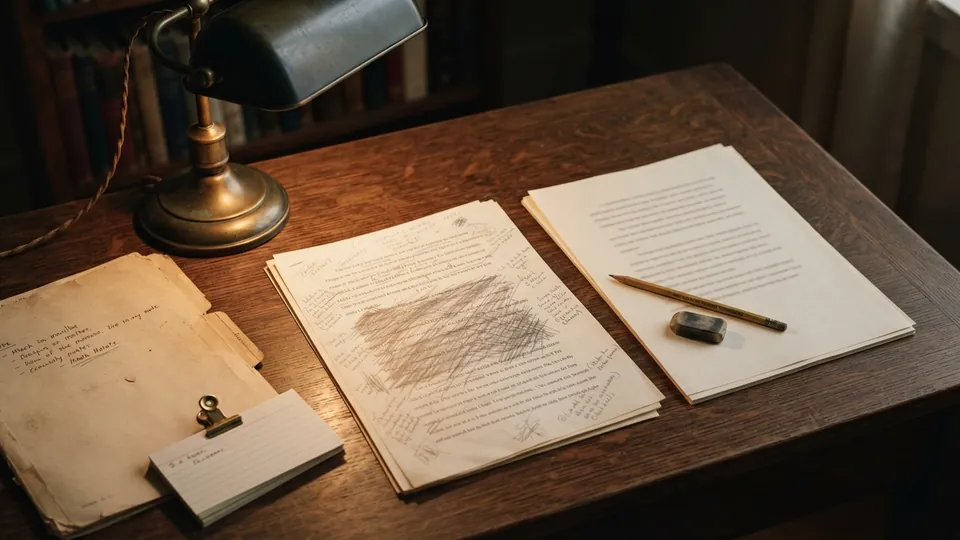
In short: Save every essay draft as a separate, dated file or named version, and let the drafts differ honestly: a weak first thesis, evidence swapped in the second, a paragraph cut in the third. That sequence sharpens the essay and, if a detector flags it, shows an instructor a writing process that a generated text does not have.
Why the essay draft matters more than it used to
For most of the history of the school essay, the draft was private. You wrote badly, then better, and handed in the final. Detectors changed that, because a detector evaluates only the finished document, and finished documents by careful students look statistically similar to generated ones. Our guide to what AI detectors look for explains why polished, even prose scores as machine output.
The essay draft trail is the answer to that problem, and it costs nothing. When Vanderbilt University disabled Turnitin's AI detector in 2023, its guidance to instructors was to compare suspect work against a student's earlier writing, check whether the sources were real, and talk to the student. A folder of drafts serves all three purposes: it is earlier writing, it shows where the sources entered, and it gives you something concrete to talk through.
So the drafting process has become part of what you submit, even when nobody asks for it. This piece treats it that way, as both a craft skill and an authorship record, because the same habits serve both.
What a real draft sequence looks like
Consider a student writing on Charlotte Perkins Gilman's The Yellow Wallpaper. Her drafts, saved four days apart, show how literary essays typically develop.
The first draft: a summary wearing a thesis
The rough draft opens with a thesis that every reader of the story could have written: "The Yellow Wallpaper shows a woman's descent into madness caused by the rest cure." The body paragraphs follow the plot in order: one on Gilman's own treatment by the physician Silas Weir Mitchell, one on John the husband, one on the ending. The evidence is mostly paraphrase. It is a competent first essay draft, and it argues nothing, because "descent into madness" is what happens in the story rather than a claim about it.
The second draft: the thesis sharpens and the evidence changes
Between drafts the student rereads with a pencil and notices how much of the story is about reading and writing. The narrator writes in secret on "dead paper" because her husband forbids it, and she spends the story reading the wallpaper as if it were a text: "This wallpaper has a kind of sub-pattern in a different shade," she reports, and later, "It creeps all over the house." The second draft's thesis becomes arguable: the narrator's madness is a reading practice pushed past its limit, and the story treats interpretation itself as the thing the rest cure tries to forbid.
The evidence changes with it. The plot-order paragraphs go. The "sub-pattern" and "creeps" lines come in, each quoted and then read closely. The paragraph on John is rebuilt around his refusal to let her write rather than his general condescension. Our guide to The Yellow Wallpaper follows the same thread through the story's final pages.
The third draft: a paragraph is cut
The biography paragraph about Weir Mitchell survives into draft two and dies in draft three, because the student realizes it argues about the author instead of the text. Cutting it hurts; it was the paragraph she was proudest of. In its place the ending takes over: "I've got out at last," the narrator says, "in spite of you and Jane!" The third essay draft closes on the puzzle of that "Jane," a name that appears nowhere else and may be the narrator's own, and argues that the woman who got out is a reader who has finally become the text.
| Draft | Thesis | What changed | What a teacher reads in it |
|---|---|---|---|
| Rough draft (day 1) | The story shows a descent into madness caused by the rest cure | Plot-order paragraphs, biography, paraphrase | A student who has read the story and has not yet found a question |
| Second draft (day 5) | The narrator's madness is a reading practice pushed past its limit | Plot paragraphs replaced with quoted passages; John paragraph rebuilt | A rereading happened; the evidence was chosen, not inherited |
| Third draft (day 9) | Same thesis, tightened; the ending becomes the closing move | Biography paragraph cut; "Jane" line added and read | Judgment about what belongs, and the courage to remove good writing |
Nothing in that table could be generated in one pass. A tool asked for an essay on The Yellow Wallpaper produces something close to the rough draft, thesis already flattened into "descent into madness," and stops. The movement from draft one to draft three is the writing. It is also the evidence.
How to name and save drafts so they document your work
The craft benefit of drafting arrives whether or not you keep the files. The evidence benefit arrives only if you do, and only if the files can be dated. Three habits make the difference.
First, never overwrite. When you begin a substantial revision, save a new file or name a new version rather than editing the old one in place. A filename that sorts correctly and states the stage is enough: wallpaper-essay-v1-rough-2026-02-03.docx, then v2-thesis-revised, then v3-final. In a cloud document, use the built-in naming. Google Docs lets the owner attach a name to any point in the version history, and Microsoft's version history for Word files stored in OneDrive keeps prior versions automatically (a personal account can retrieve the last 25). Our walkthrough of Google Docs version history as proof of authorship gives the menu paths.
Second, keep the outline and notes with the drafts. An outline dated before the rough draft shows that the argument existed before the prose, and reading notes show which passages you marked and when. A student who used the essay outline tool on this site to plan the Yellow Wallpaper essay would have a dated plan whose passages match the ones the later drafts quote.
Third, let the drafts stay ugly. Students sometimes tidy early drafts after the fact, out of embarrassment. Resist that. The weak first thesis, the paragraph you later cut, the quotation you copied wrong and fixed: these make the sequence believable. Three polished, nearly identical drafts look less like drafting than like three exports of the same file.
What a teacher can read in a draft trail that no detector can
A detector reads a finished text and measures how predictable it is. A teacher reading a draft sequence sees four things the detector cannot.
Direction. The drafts move from summary toward argument, and the movement has a shape: a question appears, evidence is tested against it, weak evidence is replaced. Generated text has no direction because it had no earlier state.
Judgment. The cut paragraph is the most telling item in any draft trail. Removing something good but off-topic is a decision only a writer with a thesis can make, and a teacher recognizes it immediately. Our essay-craft piece on close reading as a method describes the discipline that produces those cuts: staying with the words on the page until they force a claim.
Voice continuity. Across three drafts the sentences get better but the writer stays the same person, with the same tics and favorite constructions. This is the comparison Vanderbilt told its instructors to make, and a draft sequence is the most convenient way to make it.
Contact with the text. Real drafts quote the story more precisely as they go, because the writer keeps returning to it. The "sub-pattern" line enters in draft two; the "Jane" line enters in draft three. Each addition marks a rereading. Our guide to close reading versus generated analysis shows what that contact looks like in finished prose; the drafts show it happening.
If your essay is flagged despite all this, the drafts are the first thing to bring to the meeting. Our guide on how to prove you didn't use AI explains how to present them with the rest of your evidence, and our guides on authorship and integrity cover what happens next.
Frequently asked questions
How many essay drafts should I keep?
Keep every version that differs in thesis, evidence or structure, which usually means two to four for a standard literary essay. Small edits for grammar do not need their own file; a changed argument does.
Is a rough draft in a notebook useful as evidence?
Yes, and often more persuasive than a digital file, because handwriting cannot be generated and the notebook carries context: the date of the class, the notes from the lesson before it, your own handwriting throughout.
Does a first draft need to be bad?
It needs to be honest. Most first drafts of literary essays open with a thesis that is really a summary, and the revision that fixes it is the real work. If your first draft is already sharp, the outline and notes behind it become the trail.
Can I show a teacher my drafts before a problem arises?
Yes, and some instructors now ask for it. Submitting a rough draft for feedback creates a dated record in the instructor's own inbox, the strongest kind of evidence because it does not depend on your files at all.
The essay draft is the argument and the proof
Drafting was always where essays were made; it has now become where authorship is shown. Keep each essay draft as a separate dated version, let the sequence be honestly uneven, and store the outline and notes beside it. The folder that documents your work is the one that made the work better, and no detector can read either half of that.
Our close readings and sample analyses are companions for building your own essay; they are not coursework to submit as your own.
Sources
- Vanderbilt University, Guidance on AI Detection and Why We're Disabling Turnitin's AI Detector (2023): the advice to compare a suspect essay with the student's earlier writing, check sources and talk to the student.
- Microsoft Support, View previous versions of Office files: version history for Word files stored in OneDrive, including the 25-version limit for personal accounts.
- Google Docs Editors Help, Find what's changed in a file: naming versions within Google Docs version history.
- Charlotte Perkins Gilman, The Yellow Wallpaper, Project Gutenberg: source of the quoted passages.