Writing The Yellow Wallpaper Essay That Is Yours
The Yellow Wallpaper essay you have been assigned has an unusual advantage: the story is about a woman forbidden to write who writes anyway, and hides the pages. Charlotte Perkins Gilman's 1892 story is in the public domain, so you can quote it freely, and it is short enough to read three times in an evening. This guide puts a generic paragraph beside a close-read one, shows what a teacher and a detector each see in them, offers thesis directions that can be argued against, lists the lines you must quote, and explains how to keep the record that proves the essay is yours.
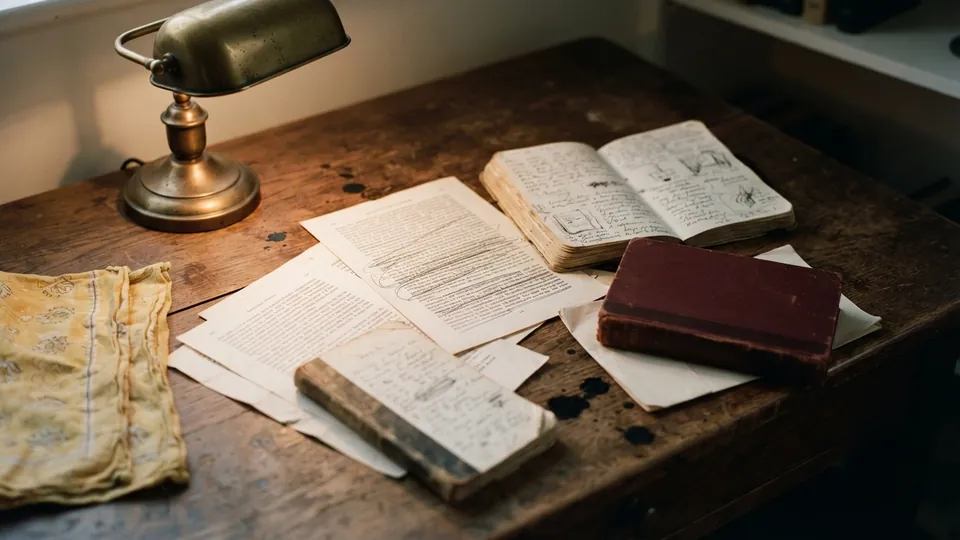
In short: a Yellow Wallpaper essay is yours when it quotes Gilman's exact words, tracks one element (the journal, John's kindness, the pattern, the verb "creep") across the story, and commits to a claim a classmate could dispute. Keep dated drafts and a marked copy of the text; that record is your answer to a wrong detector score.
Two paragraphs about the narrator's journal, side by side
Our Yellow Wallpaper work guide reads the wallpaper as the narrator's mind hung on the wall and follows the window, the room and John's language of care. This article takes an element the guide mentions only in passing, the journal itself, and shows two ways of writing about it. The left column is the flat, list-everything register; the right column is a reading.
| Generic paragraph | Close-read paragraph |
|---|---|
| The Yellow Wallpaper by Charlotte Perkins Gilman is a short story that explores themes of gender roles, mental illness, and the oppression of women in the nineteenth century. The narrator is a woman who is suffering from postpartum depression and is confined to a room by her husband John, who is a doctor. Over time, she becomes obsessed with the yellow wallpaper in the room and begins to see a woman trapped behind it. The wallpaper symbolizes the way society traps women. In the end, the narrator goes insane, which shows how the rest cure and patriarchy harm women. The story is an important feminist text that is still relevant today. | The story is a document its author has to hide. "There comes John, and I must put this away," the narrator writes; "he hates to have me write a word." Gilman makes writing the first thing the cure forbids and the last thing the narrator surrenders, and the entries thin as the summer goes on. What survives is "dead paper," her name for the journal, the one listener that will not report her to her husband. Read that way, the story's form is its argument. A mind kept from writing does not rest; it looks for another surface, and the wallpaper is the surface it finds. |
What a teacher sees
The left paragraph is accurate and inert. It lists three themes, summarises the plot, gives the wallpaper a one-word meaning and ends on a sentence that could close an essay on any text written before 1950. Nothing in it could be wrong, so nothing in it is an argument.
The right paragraph makes a claim about form (the journal's existence is the story's argument) and supports it with two quoted lines and one observation about the entries thinning. A teacher can push back: do the entries actually shorten, or does the narrator simply write less about the outside world? Answering that sends you back to the text, where an essay should send you. The method for building a claim like this is in building a thesis that is actually an argument.
What a detector sees
Detectors score how predictable a text is and how much its sentence length varies. The left column is built from the most probable phrase at every step ("explores themes of", "still relevant today") in sentences of near-identical length. The right column quotes, uses a semicolon, sets a four-word sentence beside a thirty-word one, and reaches for "surrenders" where a model would pick "gives up". None of that is a trick; it is what prose looks like after a reading, which is the whole point of proving you did not use AI by showing the work rather than arguing about the score.
How your drafts document the second one
The close-read paragraph leaves evidence: a printout of the Gutenberg text with "dead paper" underlined twice, a first draft that said "the narrator keeps a secret diary", and a revision where the diary became "a document its author has to hide". The generic paragraph leaves nothing behind because it never touched the text.
Thesis directions for The Yellow Wallpaper essay
The journal outlasts the cure. The narrator is "absolutely forbidden to 'work' until I am well again," and yet the final entry is written after the creeping, in the past tense. Argue that the story's last line proves the cure failed at the one thing it was designed to stop.
John's kindness is the mechanism of harm. He calls her a "blessed little goose," and she notes that "he does not believe I am sick!" The claim: Gilman locates the damage in affection rather than cruelty, which is why the story refuses to give John a villain's line.
The bars depend on the light. The pattern becomes bars only "by moonlight," and the woman behind it is "subdued, quiet" by day. Argue that what changes with the hour is the narrator's perception rather than the paper, and that Gilman times the story's descent to the nights.
"Jane" is the narrator's former self. The last speech, "in spite of you and Jane!", names someone the story has never introduced. Argue that Jane is the respectable wife the narrator has escaped, or argue it is a slip for Jennie; either way you are working from the one line the story leaves unexplained.
Gilman and Chopin build the same room. Kate Chopin's Louise Mallard gets an hour alone in a room and finds freedom in it; Gilman's narrator gets a summer and finds the wall. Our guide to Kate Chopin's short stories sets up the comparison; argue about why one confinement liberates and the other consumes.
Evidence you must quote
Because the story is public domain, quote exactly and generously, but cite the edition (Project Gutenberg ebook 1952 is the standard free text). These lines carry the directions above.
- Opening pages: "temporary nervous depression" and the repeated question "what is one to do?"
- Opening pages: "this is dead paper and a great relief to my mind."
- Opening pages: "absolutely forbidden to 'work' until I am well again."
- First entry: "There comes John, and I must put this away" and "he hates to have me write a word."
- Early entries: "so I take pains to control myself" and "blessed little goose."
- Middle entries: "by moonlight, it becomes bars!" and "The woman behind shakes it!"
- Late entries: "most women do not creep by daylight."
- Final entry: "I've got out at last," "in spite of you and Jane!" and "so that I had to creep over him every time!"
A process checklist for a Yellow Wallpaper essay you can defend
- Print or download the Gutenberg text and mark it by hand. Date the margin notes. Number the entries yourself, since Gilman does not.
- Choose one element to track and write a one-sentence claim about how it changes. If the sentence contains "symbolizes", rewrite it around a verb someone could dispute.
- Draft in a single document with version history on, or in dated files. Do not paste in text from anywhere.
- Quote exactly, including Gilman's exclamation marks; a misquoted line is the fastest way to lose a teacher's trust.
- Read the draft aloud and cut one long sentence in every paragraph to under eight words.
- If you used any tool, name it and what it did in a short AI disclosure statement at the end.
- Keep the marked text, the notes and every draft, and check that the file's author field and creation date are yours; our note on document metadata and authorship explains what those fields show.
Why the record beats the score
Formal, careful prose about a nineteenth-century story is the kind of writing detectors handle worst. The 2023 study by Weber-Wulff and colleagues in the International Journal for Educational Integrity tested 14 detection tools and found all of them below 80 percent accuracy, with both false positives and false negatives. Vanderbilt University disabled Turnitin's AI indicator in August 2023, calculating that even the vendor's stated 1 percent false-positive rate would have meant around 750 wrongly flagged papers out of the 75,000 it submitted the year before.
If your Yellow Wallpaper essay is flagged and you wrote it, the detector is wrong, and the marked text, the dated drafts and the disclosure note are how you show it. The Authorship pillar collects our other guides on keeping that record.
Frequently asked questions
What is a good thesis for The Yellow Wallpaper essay?
One that names a mechanism and takes a side. "The final entry, written after the creeping, proves the rest cure failed to stop the one activity it forbade" can be argued against. "The wallpaper symbolizes oppression" cannot, so it is a topic rather than a thesis.
Can I quote The Yellow Wallpaper at length?
Yes. The story is in the public domain, so there is no copyright limit. Quote exactly, cite the edition, and keep each quotation short enough that your analysis, not Gilman's prose, fills the paragraph.
Is the narrator's journal the same as the story?
Yes, and that is worth arguing about. Every word the reader has is written by the narrator in secret, including the last entry after she tears the paper down. The story exists because the cure failed to stop her writing.
How do I document that I wrote The Yellow Wallpaper essay myself?
Mark the text by hand with dated notes, draft in a document with version history, keep every version, and add a short disclosure statement naming any tool you used. That trail shows the essay being built from the story over time.
The Yellow Wallpaper essay is yours when it could be wrong
The narrator hides her pages because writing is the one act that keeps her a person. A Yellow Wallpaper essay that quotes her exact words, commits to a claim about how Gilman builds her effect, and leaves dated drafts behind it is doing the same thing in a smaller way: it makes a mind visible on paper. Read the story three times, argue one thing, and keep everything you wrote on the way.
Our essays and guides are study companions for reading and arguing better; they are not coursework to be handed in as your own.
Sources
- Charlotte Perkins Gilman, "The Yellow Wallpaper", Project Gutenberg ebook 1952: the public-domain text; all quotations are taken from it.
- Weber-Wulff et al., "Testing of detection tools for AI-generated text", International Journal for Educational Integrity (2023): 14 detectors tested, all below 80 percent accuracy.
- Vanderbilt University, "Guidance on AI Detection and Why We're Disabling Turnitin's AI Detector" (2023): the 1 percent claim and the 750-paper estimate.